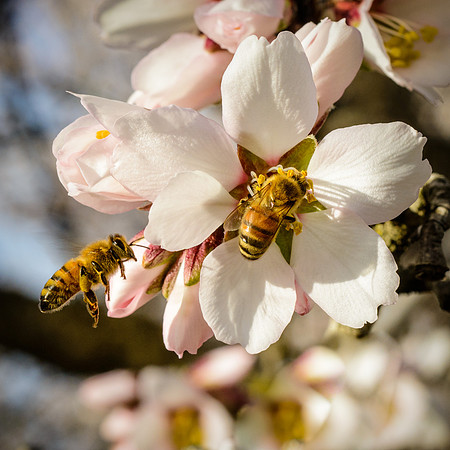
040•366 • 09 February 2016 • B is for Bee…
The first almond blossoms have arrived and the bees are busy! I found one small patch of an orchard north of Chico that was blossoming.
This image was inspired by OKDOTHIS 'DO of the Day'- "There is beauty in everyday. Photograph the most beautiful part of your daily route to work." And by a similar photo I saw on Facebook by Sarah Campbell, that was so fantabulous that I had to go out and make a similar image myself.
Mother Jones writes about the bees and one of our local "crops that feed the world"
"Holy Shit! Almonds Require a Ton of Bees
Growing 80 percent of the globe's almonds in California doesn't just require massive amounts of water. It also takes a whole bunch of honeybees for pollination—roughly two hives' worth for every acre of almonds trees, around 1.7 million hives altogether. That's something like 85 percent of all available commercial hives in the United States, Gene Brandi, a California beekeeper who serves as vice president of the American Beekeeping Federation, recently told NPR.
Now, that vast army of bees—made up, all told, of more than 80 billion flying, buzzing soldiers—doesn't stay put in California's almond-happy Central Valley all year. The almond bloom typically lasts for just a few weeks (or less) in February. The modern honeybee operation is an itinerant business—beekeepers move hives throughout the year, in pursuit of paid pollination gigs—from tangerines in Florida to cherries in Washington state—as well as good forage for honey.
But California's almond bloom is the biggest gig of all—the "largest managed pollination event anywhere in the world," Scientific American reports. And as US honeybee populations' health has flagged in recent years—most famously epitomized by the mysterious winter die-offs that began around a decade ago, known as colony collapse disorder—the almond industry has been drawing in a larger and and larger portion of the nation's available bee hives.
One question that arises is: Why do the n